


It was a long week, and Rafi was happy to finally enter into the restful and festive world of Shabbos. Just for a second he imagined- perhaps a bit too vividly- how he too was just like Hashem who also rested from Creation as the Shabbos approached. (Because obviously, managing a small farm is totally comparable to creating the entire universe.)
The passuk of the Ten Commandments from Exodus flashed across his mind, like a news ticker:
“Six days you shall labor and do all your work, but the seventh day is a sabbath of your G-d: you shall not do any work—you, your son or daughter, your male or female slave, or your cattle, or the stranger who is within your settlements. For in six days Hashem made heaven and earth and sea—and all that is in them—and then rested on the seventh day; therefore Hashem blessed the Sabbath day and hallowed it.” (Exodus 20:10-11)
Rafi slipped on his suit jacket, and he again glanced out of his window, this time finding Frederick sitting by the well, drenched in sweat from the thick evening heat sitting beside Boxer, whose flanks heaved rapidly from the relentless plowing. Frederick alternated between tilting the bucket for Boxer, and placing water to to his own parched lips.
To Rafi, Frederick's slumped shoulders and Boxer's weary stance, evoked more than just pity for their exhaustion - he felt himself being transported to another epoch of history, the endless and backbreaking toil that had defined his ancestors' existence in Egypt.
Something stirred within Rafi. The comfortable fabric of his suit suddenly felt like an uncomfortable privilege, a stark reminder of the thin line between freedom and servitude. And then, he began to think, Shabbos is also a remembrance of the Exodus from Egypt…
“Six days you shall labor and do all your work, and the seventh day is a Sabbath of your God יהוה; you shall not do any work—you, your son or your daughter, your male or female slave, your ox or your donkey, or any of your cattle, or the stranger in your settlements, so that your male and female slave may rest as you do. Remember that you were a slave in the land of Egypt and your G-d freed you from there with a mighty hand and an outstretched arm; therefore your G-d has commanded you to observe the Sabbath day.” (Deuteronomy 5:14-15)
Rafi burst from the house, his polished shoes kicking up small clouds of dust. "Frederick! Harriet!" he called, his voice uncharacteristically urgent.
Frederick looked up, confusion etched across his weathered face, and Harriet paused just as she was going to put a fresh brown egg into her wicker basket.
"Today is Shabbos," Rafi declared, "and today, you both rest.”
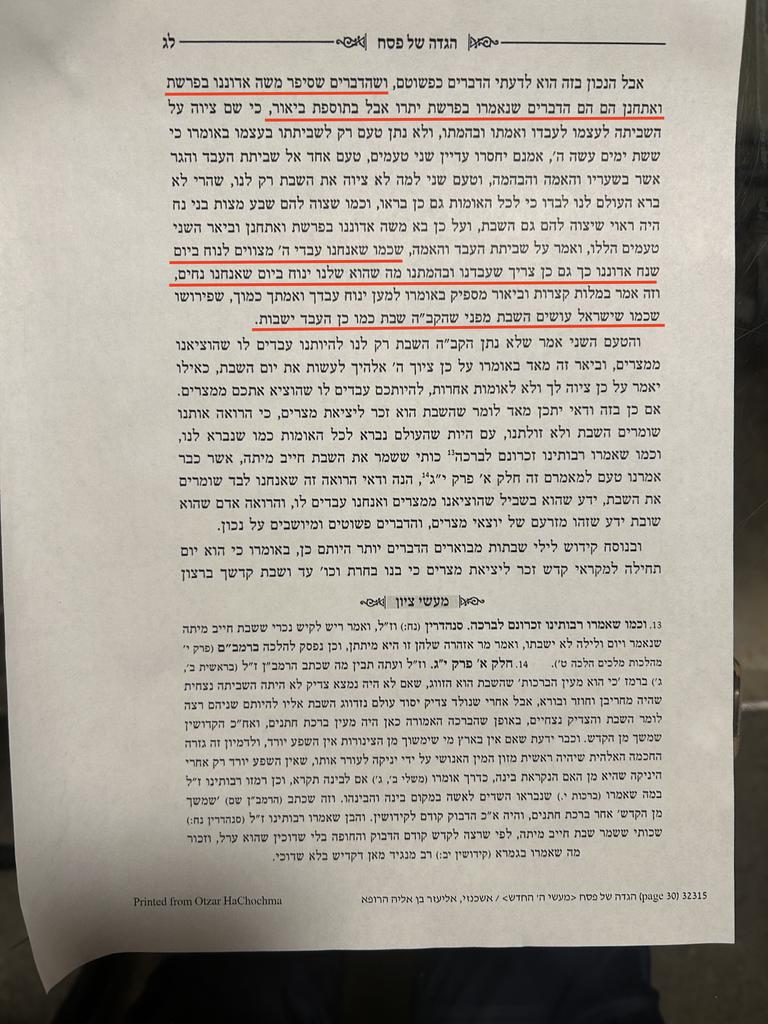
The Maasei Hashem says that the passage in Deuteronomy about the mitzvah of Shabbos “fills the void” that the passage in Exodus left left. In the passage in Exodus, although the Torah commands one to let his slave rest, however, since the reason given for Shabbos is in order to commemorate the Creation, the obligation to rest on Shabbos only includes an individual who has agency over himself, but why should the allowance to rest extend to a slave or a maidservant?
This question is left unanswered from just reading the First Commandments. The Second Commandments in Deuteronomy provide the answer: By remembering how we were once slaves in Egypt and Hashem released us and let us “rest”, it should stir us to emulate that which Hashem did for us and in turn let our slaves rest.
Shabbos thus has a dual purpose; it is a time to mirror Hashem’s actions of how he rested on the Primordial Shabbos, by abstaining from work*, and the second reason for keeping Shabbos, to remember that Hashem freed us from the bondage of Egypt, acts as a springboard to help us to emulate Hashem’s ways to do kindness to our slavea maidservant’s (and in general to cultivate the middah of benevolence).
This really goes to the heart of Yiddishkeit as a whole, I think. Yiddishkeit is not a selfish pursuit of only focusing on creating our own relationship with Hashem, but a journey of gaining knowledge of Hashem’s ways and translating those ideals into actionable traits like benevolence and kindness towards others- no matter what class they are in.
And perhaps this is why Shabbos is such a cornerstone to the Jewish belief, it is truly the “whole enchilada” when it comes to connecting to Hashem as well as showing care and concern for all living beings.
Good Shabbos!
*See Torah Avraham (Shabbos V’Ila 4) who discusses how keeping Shabbos because of how Hashem rested on Shabbos is indeed a kiyum of v’halachta bidrachav)
(10) ...But the seventh day is a sabbath of your God יהוה: you shall not do any work—you, your son or daughter, your male or female slave, or your cattle, or the stranger who is within your settlements. (11) For in six days יהוה made heaven and earth and sea—and all that is in them—and then rested on the seventh day; therefore יהוה blessed the sabbath day and hallowed it.
(14) but the seventh day is a sabbath of your God יהוה; you shall not do any work—you, your son or your daughter, your male or female slave, your ox or your ass, or any of your cattle, or the stranger in your settlements, so that your male and female slave may rest as you do. (15) Remember that you were a slave in the land of Egypt and your God יהוה freed you from there with a mighty hand and an outstretched arm; therefore your God יהוה has commanded you to observe the sabbath day.
(א) ... וְאָמַר כָּאן לְמַעַן יָנוּחַ עַבְדְּךָ וַאֲמָתְךָ כָּמוֹךָ וְזָכַרְתָּ כִּי עֶבֶד הָיִיתָ וְגוֹ', לְבָאֵר כִּי בּוֹ יְצַוֶּה בִּמְנוּחַת הָעֶבֶד כָּמוֹךָ בַּעֲבוּר שֶׁהָיִיתָ עֶבֶד וְהִנִּיחַ לְךָ הַשֵּׁם, וְגַם אַתָּה תַּנִּיחַ לְעַבְדְּךָ. וְהִנֵּה טַעְמוֹ כְּשֶׁיָּנוּחַ עַבְדְּךָ וַאֲמָתְךָ כָּמוֹךָ תִּזְכֹּר כִּי עֶבֶד הָיִיתָ וְגוֹ':
(1) ...He stated here that thy manservant and thy maidservant may rest as well as thou; and thou shalt remember that thou wast a servant in the land of Egypt etc.,155Verses 14-15. in order to explain that He commanded concerning the resting of the servant as well as yourself, because, since you were a servant and G-d gave you rest, so you too are to give rest to your servant.156The primary concern of this law is thus not that the servant should have rest, but that we are to remember that we were servants and G-d made it possible for us to rest, and therefore we should give rest to our servants (Bachya). Thus we are prevented from becoming self-righteous as a result of “magnanimously” granting a day of rest to our servants. On the contrary, kindness to servants should be utilized as a reminder to us of our former humble position and of G-d’s kindness to us which we are to emulate to others.
Thus the sense of the verses is as follows: “When your manservant and your maidservant will rest as well as you then you will remember that you were a servant etc.”
(ב) למען ינוח. הוסיף לבאר טעם עבדך ואמתך, וזכרת כי עבד היית והניח עבדך על כן צוך ה' אלהיך לעשות כן ביום השבת והטעם למנוח' העבד.
וי״א כי העבד לא ינוח והנה השם הוציאך מעבדות, וצוך שתנוח למען תזכור כי היית עבד ובצווי כבד כאשר צוך כאשר פירשתי:
(2) THAT…MAY REST. Scripture here adds the explanation of the law regarding the man-servant and the maid-servant, [why are they are to rest on the Sabbath,since this explanation is not found in the parallel verse in Exodus. The answer is, that since Hashem freed us from Egypt and thus brought his "servants" to "rest", therefore Hashem commanded that we also give our servants to rest on Shabbos.
Consequestly, when the passuk says, "Therefore the Lord your God commanded
[thee] to do this on the Sabbath day "refers to giving rest to one’s servant.
Some offer another meaning for "And thou shalt remember that thou was a servant" that Hashem commanded you to rest so that you will remember that you were a slave.35According to this interpretation, it is not a reason for giving the servant rest but it is a reason why the Israelite himself must rest. Since he was once a servant and Hashem freed him, therefore he must rest on because his rest will remind him that he was a slave and that God freed him.
I'm still grappling with which is the catalyst and which is the result; in other words, does the resting of the slave cause one to then remember that Hashem also took us out of Mitzrayim, or is it the opposite, that since Shabbos is Zecher L'Yeztias Mitzrayim?
From the Ibn Ezra it's mashma that Zecher L'Yetzias Mitzrayim brings about the resting for the slave. (This is how I explained in the "story" above)
It would seem that the Maasei Hashem is also taking that route.